Author/journalist Joel Gausten talks with guitarist Michael Abdow (Fates Warning/Ray Alder/Solo) about his new solo album, Séance in Black, and Fates Warning's current status and possible future.
EMAIL JOEL at gaustenbooks@gmail.com

Author/journalist Joel Gausten talks with guitarist Michael Abdow (Fates Warning/Ray Alder/Solo) about his new solo album, Séance in Black, and Fates Warning's current status and possible future.

 |
| Mike Patton of Mr. Bungle |
“Joel! Joel! You’ve gotta hear this band another student played me—Mr. Bungle! ‘My Ass Is on Fire’ is incredible! I can’t stop listening to it!”
Those were the words my old drum teacher, the late Keith Necessary, shot off as he bounced excitedly into the room one day in 1991. Keith was a true pro musician who had kept the beat for bloody James Taylor, for fuck’s sake, so his enthusiasm instantly carried weight for me—especially since a band with a song called “My Ass Is on Fire” typically wouldn’t be in the guy’s wheelhouse. Hell, Mr. Bungle wasn’t in anyone’s wheelhouse when it delivered its eponymous Warner Bros. Records debut—still one of the most beautifully batshit major-label albums ever released—32 years ago.

Formed in California in 1985, Mr. Bungle began as a high school Metal band with a penchant for the bizarre. Musically, the band’s 1986 demo, The Raging Wrath of the Easter Bunny, fell between Possessed and Fishbone. Weird, right? Well, by the time Mr. Bungle scored its big record deal a few years later (a feat undoubtedly helped along by the fact that the group’s frontman, Mike Patton, had recently reached hitmaker status with his other band, Faith No More), its sonic shitstorm of eclecticism had reached epic proportions. This musical mindfuckery lasted for another nine years and two more albums before the band called it a day in 2000.
 |
| Scott Ian of Mr. Bungle |
Fast-forward to February 2020. Seemingly out of nowhere, a revamped incarnation of Mr. Bungle—Patton, original guitarist Trey Spruance, original bassist Trevor Dunn, Anthrax/Stormtroopers of Death (S.O.D.)/Motor Sister guitarist Scott Ian, and drummer extraordinaire Dave Lombardo (Slayer/John Zorn/Grip Inc./Misfits/Suicidal Tendencies/Testament/Dead Cross)—hit the stage for a handful of shows comprised largely of material from The Raging Wrath of the Easter Bunny. Although the group’s fanbase was delighted to have it back, more than a few followers balked at the lack of music from its Warner Bros. era in the set. (Frankly, there’s something so perfectly Mr. Bungle about the band reforming to primarily play its primitive material from the mid-’80s when 95 percent of its audience had anticipated something else entirely.)

Later in the year, this lineup released The Raging Wrath of the Easter Bunny Demo, a studio re-recording of several tracks from the original 1986 tape along with a sprinkling of covers and renditions of tracks written in the old days but never recorded. A Halloween 2020 livestream event was later released as The Night They Came Home.
 |
| Trey Spruance of Mr. Bungle |
Earlier this month, Mr. Bungle brought its Easter Bunny-centric live show back on the road for a handful of dates that included its first Boston show in nearly 24 years. Hitting the stage at Roadrunner on September 11, the band savaged the crowd with … a cover of Fred Rogers’ “Won’t You Be My Neighbor?” (?!?!). The esoterica escalated from there.

One moment, the band was blasting through the Easter Bunny track “Anarchy Up Your Anus.” The next moment, it was delivering a note-perfect version of Spandau Ballet’s “True.” (Really.) The evening’s covers repertoire included D.R.I.’s “I Don’t Need Society,” 10cc’s “I’m Not in Love” (!!!), Seals and Crofts’ “Summer Breeze” (with expletives added for flavor), Corrosion of Conformity’s “Loss for Words,” the intro to Slayer’s “Hell Awaits,” S.O.D.’s “Speak English or Die” (rechristened “Habla Español o Muere”), Timi Yuro’s “Satan Never Sleeps” (dedicated to the recently departed Pee-wee Herman), and “Cold War” by Massachusetts underground legends/Grindcore progenitors Siege. When the band got around to playing, you know, Mr. Bungle songs, it stuck to 1986 apart from an incendiary run through “My Ass Is on Fire” during the encore. The WTF? nature of the band’s setlist felt like either the most outstanding travel playlist of all time or just a really good afternoon on WFMU. Either way, it was glorious.

As much fun as the packed Roadrunner crowd had that evening, seemingly no one had more of it than Scott Ian, whose wide smiles toward the photo pit during the first three songs just screamed, “Man, look what I get to do right now!” Roughly 18 months shy of 60, Lombardo still reigns as one of the greatest living drummers in Metal (even if the band’s frustratingly murky light show left him obscured in darkness for most of the night), while the ever-versatile Spruance and Dunn still perform with Zappa-meets-Zorn smarts.

.jpg) |
Top L-R: Doug Graves, Cunnus (The Metal Witch), Fancy Cymballs, Bottom L-R: Kandi Moon, Wendy Stonehenge, Lorfin Terrafor Photo Credit: Tash de Valois (New Pleasure Photos IG: @newpleasure.photos) |
Glitter Wizard is both a dream come true and an utter nightmare for a music journalist.
On the one hand, the long-running San Francisco-based band’s sprawling musical vocabulary and eclectic discography are enough to make even the most jaded scribe stand up and take notice. On the other hand, how in the ever-loving hell does this journalist even begin to do the band’s esoteric explorations justice with mere words? Simply put, Glitter Wizard is something you need to listen to and see live—and not simply read about—to fully understand.
With my nifty get-out-of-jail-free card of an introduction out of the way, please allow me to direct your attention to the band’s latest release, Kiss the Boot. Out now on Kitten Robot Records, this six-song EP is simultaneously the most accessible and most head-scratchingly unconventional chapter in the group’s history. A drastic departure from the band’s past efforts (which at times have sounded like Master of Reality-era Sabbath jamming with Fun House-era Stooges), Kiss the Boot finds Glitter Wizard in full-on Sweet-meets-Slade ’70s Glam mode—complete with a cover of “Suffragette City” (a tune by some guy who had a hit or two back in the day) and a suitably outlandish image that straddles the line between piss-take and sincere homage.
What do Glitter Wizard’s Kiss the Boot’s originals sound like, then? Oh, Christ, here comes the tough part. Okay … imagine The Darkness covering The Supersuckers with Kim Fowley in the producer’s chair.
Yeah, that’ll do.
To take in some of the Kiss the Boot phenomenon for yourself, check out the freshly baked video for “Glitterati”—which sees the band transformed into puppets performing on the fictitious (and brilliantly ’70s) variety show Pop Toppings—below.
(Seriously, watch this thing. This is the best video you’ll see this year. Trust me.)
Although Kiss the Boot is unlike anything else Glitter Wizard has ever conceived, guitarist Lorfin Terrafor sees it as just another example of the band’s moving-target nature.
“[Our fans] are seeing a different chapter, and that’s kind of the beauty we’ve always had with this band. If you sat down and listened to each album, they’re all quite different. The excitement the fanbase is having is, ‘Wow, this is something completely different!’”
Delivering “something completely different” is the spirit behind the Glitter Wizard’s annual “Hallorager” events—full concerts that pay tribute to a specific artist each year. Past honorees include The Damned, Funkadelic, The Piper at the Gates of Dawn-era Pink Floyd, The Seeds, Blue Öyster Cult, The Cars, The New York Dolls, and Alice Cooper. Currently, the band boasts more than 100 songs—including the most extraordinary and original rendition of a Black Sabbath song this writer has ever heard—in its covers repertoire.
“Every time you cover a song, you learn about how other people play,” bassist Kandi Moon explains. “You can get into their mindset, which helps us switch gears but not force it.”
Kiss the Boot was conceived during the COVID-19 lockdown, which found the members of Glitter Wizard trading demos remotely instead of their traditional practice of writing songs together in person.
“It was cool to experiment with the songwriting; it was more melody-based instead of Lorfin coming up with crazy riffs and [singer] Wendy [Stonehenge] trying to figure out where his vocals go,” observes Moon, who relocated to San Diego during the pandemic. “[This EP] was kind of built around his vocals, and we got to demo stuff—which we hadn’t really done before. Regardless of the direction it goes from here, I’d like to continue the demoing, because I think it roots out a lot of bullshit and you can really hear what works and what doesn’t.”
.jpg)
Paul Roessler, a veteran musical alchemist whose career has included stints with The Screamers, 45 Grave, and his group, Twisted Roots, recorded Kiss The Boot at LA’s Kitten Robot Studios.
“Being Screamers fans, we were stoked!” Moon says of having Roessler involved in the project. “It was like, ‘Seriously? Paul Roessler from the fucking Screamers is going to record it?’ I just wanted to go hang out with him. (laughs) He still has the synth with all the broken keys and stuff from The Screamers in the studio. Paul was great; he was very easy-going, super-accommodating, and willing to try everything.”
Roessler speaks well of the experimental—and ultimately liberating—nature of the Glitter Wizard sessions.
“When they came in, they said, ‘We want to record two different drum sets. We want to record a really live drum set, and then we want to record really dead drums.’ I try to be super-efficient—getting people in and out and saving them money. I was like, “For your six songs, we basically have to completely change the drum sound?’ (laughs) I thought to myself, ‘Oh, okay … that’s fancy,’ but I’ve got to say, it was fucking awesome. For the dead drums they made, they put towels over them and taped the shit out of them. It sounded so great; I didn’t even want to change them. It was cool that they had that much vision. Some songs had a Ringo, dead drum sound, and other songs had big, live, bombastic drums. I would have done a lot of that stuff on the back end [with mixing], but they wanted to do it on the front end—and that was revelatory and awesome.”
This approach is exemplified on the Kiss the Boot track “Sugar Beat,” an instantly memorable slice of ‘70s-style Glam.
“[Glitter Wizard manager] Bruce [Duff] and I kind of researched different tonal qualities for the drums to give it that muted-tom slapback mixed with the clap—like that classic Gary Glitter sound,” Moon recalls. “We tracked six tracks of all five of us clapping, so there’s like 30 claps on there drenched in the slapback delay. Bruce [who mixed the record] was like, ‘The feedback from the delay is louder than the clap,’ and that’s what gives it that weird, crunchy, slapback delay sound to it.”
Not surprisingly, the bassist left Kitten Robot Studios thrilled to have had the opportunity to work with a kindred sonic soul.
“Paul definitely has a lot on his plate [at the studio], but he was in it. He was picking up on stuff that I didn’t even notice […] He’s got a great ear.”
Kiss The Boot isn’t the first time that Glitter Wizard has worked with a Punk legend in the studio. The group’s 2011 album, Solar Hits, featured none other than Stooges saxophonist Steve Mackay on the tracks “Mirror Man” and “Summertime.” Mackay, who previously played with Glitter Wizard keyboardist Doug Graves in the band Liquorball, was a very welcome addition to the album sessions.
“When we found out that Steve was an option, it was basically a no-brainer,” Terrafor says. “It was like, ‘Are you kidding?!’ [The Stooges] was my favorite band growing up; that was what brought me into music. The moment he walked in, I just giggled!”
Naturally, Mackay’s appearance on Solar Hits stood out a mile—and not just for the obvious reasons that any Stooges fan would expect. While recording “Mirror Man,” he hit a bum note but soldiered on through the end of the track. Although Mackay was initially upset with himself for the goof, Terrafor and the rest of Glitter Wizard were pleasantly surprised by how well it fit the song.
“We listened back to it and said, ‘You know, we’re not too bothered.’ Sometimes, mistakes are hidden gems!”
The guitarist adds that Mackay suddenly dropped his sax and started yelling during the recording of the raucous freakout ending to “Summertime.”
“He was like, ‘I’m sorry. I was caught up in the moment! I felt the song really hard. I just wanted to yell.’ We were like, ‘That was perfect! You couldn’t have done anything better at that moment.’”
Twelve years after sending a sonic charge through a Stooge’s body, Glitter Wizard is still delivering the same experiences to audiences. With Kiss the Boot already the most acclaimed release of the band’s career (and with talk of European dates in 2024), this assemblage of try-anything musos is poised for an adventurous future—in whatever unpredictable direction it decides to go.
As Terrafor says, “Right when you think you get to know us, there’s a wild card!”
 |
| Photo: Heidi May (www.facebook.com/officialhenryrollins) |
If you don’t think there’s a mental health crisis in this country, you’re not paying attention.
Driven by the pandemic, a precarious economy, and the perpetually fractious state of politics, the collective mindset of American citizens is exhausted at best and dangerously depressed at worst.
New Hampshire hasn’t been immune to this trend. With its $7.25 minimum wage, staggering human services backlog, and ongoing opioid crisis, the “Live Free or Die” state serves as a distressing microcosm of where our nation stands in 2023.
According to an August 7 article in New Hampshire’s Union Leader newspaper, “data from American Medical Response (AMR) show the number of suspected overdoses in the state’s two largest cities [Manchester and Nashua] in July are at the highest they’ve been since 2018.”
Is there an antidote to such self-destruction? Henry Rollins thinks so.
At 62, the world-traveling spoken word artist, actor, TV host, and former Black Flag/Rollins Band frontman has seen and survived it all. A journey through his numerous books and recorded speaking shows reveals a life of childhood abuse, depression, financial ups and downs, interpersonal woes, intense personal discipline, and an unwavering will to move forward. Once you get past his stern stare and intimidating musculature, you’ll discover a disarmingly polite, empathetic, straightforward, and goal-focused man who gets things done—the kind of person you can always depend on to come through without a shred of runaround. (Since his first appearance on this site in 2014, Rollins has maintained the fastest interview request response time of the hundreds of artists I’ve dealt with over the years. Respect.)
Rollins will share some of his hard-earned experiences and worldview with a New Hampshire audience when he brings his spoken word tour to a sold-out show at the Bank of NH Stage in Concord on September 22.
Considering that his performance will occur down the street from many of the city’s behavioral health centers, it’s no surprise that the topic of drug use came up in our recent exchange. Although he had dalliances with drugs in his earlier years (and detailed some of these experiences on a 2017 episode of his Henry & Heidi podcast), he has shunned illicit substances for decades.
“I tried marijuana and LSD—interesting but nothing I wanted to make a career out of. It was never a matter of having to resist any temptation; I just didn’t enjoy the effects. I found it all to be depressing. The more I saw drugs and alcohol do damage to young people around me, I concluded all drugs and alcohol were traps to marginalize those young people and neutralize the masses. Basically, it’s what The Man does to keep the people doped and docile. That alone is enough to keep me away from any and all of those poisons. As soon as you’re high, you’re prey to law enforcement. I will never give them that advantage.”
Rollins’ ability to rise above life’s tribulations comes down to keeping his body healthy and his mind sharp. Not surprisingly, having great tunes at the ready has helped him along the way.
“For me, music is a great anti-depressant. It’s also great company. I’m an extremely solitary person, and while I don’t feel the need to be with anyone, I do like having music on.”
As for his diet, he keeps things very simple—and avoids the kinds of comfort food that often provide temporary mental relief for many folks but ultimately leave them in even worse physical and mental shape than before they downed that meat lover’s pizza or drive-through cheeseburger.
“I eat a lot of spinach and other vegetables, [along with] Athletic Greens super-food powder and beet extract powder once a day. Post-workout, which is six times a week, I usually take these two with a scoop of vegetable-based protein and then nothing until I’m done with work for the night, which is around 2330 hours. For me at least, diet is perhaps the most important thing I do for my mental health besides going to the gym. You have to stay up on it, and it’s not always easy, but this is what I do—no matter where in the world I am.”
These things sound great, but are they easier said than done? Just look at the arts. It’s no secret that many creative types often lean on questionable habits to help fuel their output. This writer knows plenty of fellow scribes or musicians who are afraid to get sober out of fear of losing their creative thing without the crutch. After all, no writer wants to stare at a blank screen as nothing comes to them. Naturally, Rollins has some no-nonsense advice for anyone who’s holding off on getting clean for this reason.
“I’d say they’ll probably get a lot more quality work done without the stimulants, and they might find the work they did while under the influence will be inferior to what they’ll achieve without the ingredients. If I write a book, I want to be able to put my name on it, not my name along with ‘and Heroin.’”
With COVID-19 on the rise again and gas prices in New Hampshire nearing $4 a gallon as of this writing, it appears that everyday survival will remain a struggle for many citizens as this country gears up for another presidential election. If the recent Republican debate is any indication, we—especially our young people—are about to experience yet another wild ride. Based on Rollins’ various travels across America, how politically minded would he say people in their late teens/early 20s are these days? How can getting involved in activism locally (or beyond) help a young person channel their stressors in an outward direction as opposed to keeping them inside and burning themselves out?
“In my vision for the U.S.A. being in a better place at the end of this century than it was at the beginning, I would hope all young people who can vote will do so. I would like them to see the truth: It’s their time, their country, and their future. If they don’t get on it, a bunch of pasty old white men are going to do their best to create a world they won’t even be alive long enough to suffer through. The young must take the power from the old at every possible opportunity. There’s no need to ever burn out—you just keep making things better with the understanding that most, if not all, established power structures are money-minded and that your health and happiness are not in their calculations. This is why bad food, drugs, and stupidity are so easily accessible and in such great supply in the U.S.A. Freedom is a tricky thing. You see how many adults obviously can’t handle it.”

More on Henry Rollins on This Website:
 |
Twenty years ago, I moved to Los Angeles from New Jersey in search of new adventures. I soon found myself playing drums in one of the countless bands trying like hell to make a name for themselves around town. Before long, I realized that most of the LA music scene wasn’t to my liking—too precious, too pretentious, too forced, too hipster-y. Worst of all, it just didn’t ROCK enough or have very much to say. Unbeknownst to me, a group of thirtysomethings calling itself The Hold Steady was cutting its teeth 3,000 miles away in New York and quickly building a devoted audience by delivering everything I had craved at the time.
Shamefully, I had remained ignorant of the band’s existence for another 18 years. One evening in 2021, a YouTube search for something new brought me to “Lanyards,” a song off the band’s then-current album, Open Door Policy. I was floored. The tune had it all—exquisite instrumentation, a solid production, and Tom Waits-level lyrical genius that took my mind on a cinematic journey. Most intriguing of all, the words were delivered by a guy who sounded like a cross between Randy Newman and Bob Mould.
It was my favorite song of that year, and I was hungry to learn more about this band that had stopped me in my tracks.
Thankfully, I didn’t have to wait too long. Published last month by the great Akashic Books, The Gospel of The Hold Steady: How a Resurrection Really Feels is a gorgeously presented oral history that details everything from the band’s earliest days to its gradual development of an international fanbase that functions more as a tightknit family than as a mere audience. Written by the band and Michael Hann (Denim and Leather: The Rise and Fall of the New Wave of British Heavy Metal), this beautiful hardcover tome features more than 200 photos and images to help tell the tale.
And the story is a great one: The Hold Steady goes from playing clubs to sharing the stage with The Rolling Stones, addiction threatens to derail its momentum, a member gets evicted from his place during lean times, bandmates get on each other’s nerves way too often, and a hiatus helps recharge everyone’s batteries before they make a momentous comeback. Sure, these are stories that virtually every working band could share on any given day (well, except for the Stones part), but they’re rarely told with such personality, candor, and humanity.
While The Hold Steady’s members are certainly a colorful bunch, their words aren’t the ones that make The Gospel of The Hold Steady truly shine. That honor goes to the assortment of fans whose recollections and tributes comprise 20 percent of the book’s pages. From hilarious and silly to poignant and heartbreaking, these passages showcase how much this band has impacted people’s lives. They’re an extraordinary read about an extraordinary band.
Full marks to Akashic for once again delivering an exceptional music-related title. (Its 2014 book on The Jesus Lizard is a must-read.) Kudos as well to Sohrab Habibion, whose interior design work has raised the bar for books of this nature.
Just like the band that fueled its creation, The Gospel of The Hold Steady: How a Resurrection Really Feels is a treasure.
Who was Rolling Stone’s “Hot Band of 1991”?
If you guessed Nirvana, you’re wrong. Pearl Jam? Not even close.
When the magazine published its annual “Hot” issue on May 16 of that year—four months and eight days prior to the release of a little album called Nevermind— it bestowed its high honor upon Enuff Z’Nuff, a band that had already received weeks’ worth of critical acclaim for its second album, Strength.
Formed in Illinois in 1984 and initially heard by the masses via a self-titled 1989 album on ATCO Records, Enuff Z’Nuff—fronted by the duo of singer/guitarist Donnie Vie and bassist Chip Z’ Nuff—quickly became MTV darlings via a pair of bulletproof singles (“New Thing” and “Fly High Michelle”) that were accompanied by suitably glammy videos. (This was still the era of Aquanet-spraying dudes in lipstick, after all). Sure, the fellas were kitschy and fun, but the over-the-top image that accompanied their debut album often overshadowed the fact that Chip and Donnie were extraordinary Power Pop songwriters who could give Squeeze’s Difford and Tilbrook a run for their money. (Image “Fly High Michelle” without the outlandish video and the glossy production of its era. I rest my case.)
Strength was Enuff Z’Nuff’s opportunity to shake off its “Glam” tag and be considered for its actual songs—and for a short time, the move had paid off. Arguably the best entry in the group’s lengthy discography, Strength was a Beatles-meets-Badfinger-via-Bon Jovi tour de force that should be one of the albums readily on top of music lovers’ minds today when they think back to the year that spawned it. Of course, the music industry had changed considerably by the end of ’91, and Enuff Z’ Nuff's it-thing spotlight had already started to fade.
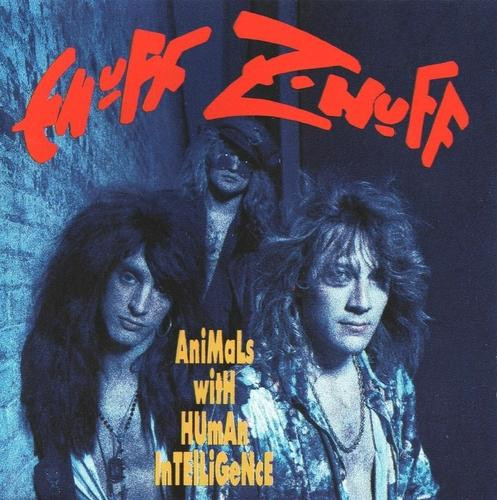
Of course, nobody in the Enuff Z’Nuff camp knew that at the time. The band began recording what would become 1993’s Animals with Human Intelligence with the support if its new label, Arista. The band also had powerhouse manager Herbie Herbert—best known as the man who guided Journey toward stadium-level success—in tow. Famed Def Leppard engineer Nigel Green signed on to mix the record, and Arista head Clive Davis brought in Richie Zito—who had produced hits for Heart, Cheap Trick, and Poison—to put his finishing touch on the proceedings after the band had already completed a good chunk of the album on its own at the Chicago Recording Company. Hell, even the likes of Dweezil Zappa, Steve Stevens, Cinderella, Stevie Salas, Micki Free, and Cheap Trick’s Rick Nielsen would stop by the sessions to check out how things were going.
The above scenario was just too perfect for the world of Rock ‘n’ Roll. Naturally, it didn’t take long for things to go sideways.
“Unfortunately, Richie didn’t show up for some of those sessions because he was robbed at his house one night, kidnapped, and thrown into the trunk of his car with his wife! A neighbor heard him banging on it!” Chip recalls. “Obviously, it ruffled his feathers, but he ended up coming to do some stuff [with us] over at One on One Studios and A&M Studios in Los Angeles. We did overdubs [with him], but the guitar was too loud for Richie to handle."
To make matters worse, long-serving drummer Vik Foxx bailed at the end of the album’s sessions to take a gig with then-former Mötley Crüe singer Vince Neil. Chip, Donnie, and guitarist Derek Frigo soldiered on with new timekeeper Ricky Parent.
Despite these bumps in the road, Enuff Z’Nuff ended up with another fantastic album.
“Clive chose the songs, and we provided him with strong material. Sonically, Animals with Human Intelligence is probably one of the strongest records we’ve ever recorded.”
Right from the first notes of album opener “Superstitious,” it’s difficult to disagree with Chip’s appraisal of the 12-song collection. Boasting hooks for days and expertly produced to power up its every note, Animals with Human Intelligence was a perfect album for Rock radio in 1993. “Black Rain,” “Master of Pain,” and “Bring It on Home” sat very comfortably next to Soundgarden or Stone Temple Pilots, while the record’s best number, “Mary Anne Lost Her Baby,” flawlessly married the sonic grit of the early ’90s with the ’80s glaze that had once made Enuff Z’ Nuff shine. Hell, even the album’s big power ballad, “Right By Your Side” —a track that stays in your head for days upon first listen—had enough balls to it to overcome any eye-rolls from the Siamese Dream crowd.*
Not surprisingly, expectations within the Enuff Z’Nuff camp were high. Unfortunately, excitement over the album’s potential chart performance was short-lived.
“It was a solid record; we could tell we had something special,” Chip says. “But at the time it came out, there was a changing of the guard in the music business. You had Pearl Jam, Soundgarden, Alice in Chains, Nirvana—all that stuff was coming in. Bands that were considered colorful and flamboyant were pushed to the side for a while—there was a whole new musical trend that was happening.”
Obviously, Enuff Z’ Nuff wasn’t the only band affected by the shift. Despite delivering one of their heaviest albums ever with 1993’s Revenge, the members of KISS quickly found themselves playing to half-empty arenas. Released the same year, Warrant’s decidedly unglamorous Dog Eat Dog got the era’s sound right but failed to connect with record buyers. The following year, a Vince Neil-less Mötley Crüe released a self-titled album that successfully captured the vibe of the times but ultimately stiffed in the marketplace. The party was over.
As great as it was, Animals with Human Intelligence didn’t stand a chance. For one thing, the album cover shot of Donnie, Chip, and Derek looked like a relic from a discarded era. Looking back now, it seems insane to assume that anyone in 1993 outside of the group’s devoted fanbase would have given the thing a listen. Before long, Enuff Z’Nuff would learn exactly how much the world had changed.
On the first night of the tour in support of the album, the band’s bus hit another car while pulling out of a venue in Iowa. Things got worse from there.
“Instead of playing to a jam-packed 800-seat venue, there would be 300 people there,” Chip reveals. “We were following around a band called Korn, and all their venues were 1,000-seaters. We just knew we were in big trouble. We sold about 250,000 copies of the album. Back then, that was considered a failure. We continued to move forward. We toured for a whole year on that record, and we went into considerable debt.”
Enuff Z’Nuff’s relationship with Arista didn’t fare much better. During the band’s showcase at the Roxy in Los Angeles for Davis and his constituents, Donnie stuck a dozen red roses between Davis’ legs as he introduced his new signees on stage—perhaps not the best way to endear yourself to a new boss.
To be fair, Animals with Human Intelligence did get a decent promotional push. The band performed “Superstitious” on Late Night with David Letterman, and longtime friend and fan Howard Stern still hyped the band on his airwaves. But it was too late.
As the dust settled, Herbert suggested that it was time for the band to part ways with Arista. Chip agreed.
“Herbie told us that we had confused motion with progress. In hindsight, I can see how Arista had trouble with Rock bands—Clive was used to signing bands that had Pop hits. We found ourselves in a position where we had to go somewhere else. We thought perhaps we’d go the indie label route.
“A lot of bands went away or took a break, but we continued to work and put out records,” he adds. “We were hungry, and we didn’t want to stop. We knew we had good music and songs and made solid records. It was just a matter of finding an audience that would listen to us.”
Fortunately, that’s exactly what Enuff Z’Nuff did. Although the crowds are smaller now than they were in the band’s ATCO heyday, Chip (who now fronts the band on vocals in addition to playing bass following Donnie’s departure a decade ago) has consistently released stellar music for the past 30 years—including five Enuff Z’Nuff albums and a solo release (Perfectly Imperfect) from 2016 to 2022 alone.
Sadly, Derek passed away in 2004, followed by Ricky three years later.
“Right By the Side” had some legs in the ensuing years. The song was covered with tremendous Pop aplomb by the Norwegian group The Tuesdays in 1995. Fourteen years later, Chicago-based rapper Malik Yusef—with Kanye West and Destiny Child’s Michelle Williams in tow—gave it the Hip-Hop treatment on his G.O.O.D. Morning, G.O.O.D. Night album.
In celebration of its 30th anniversary, Animals with Human Intelligence will receive a vinyl, digital, and CD re-release** by Deadline Music on September 29.
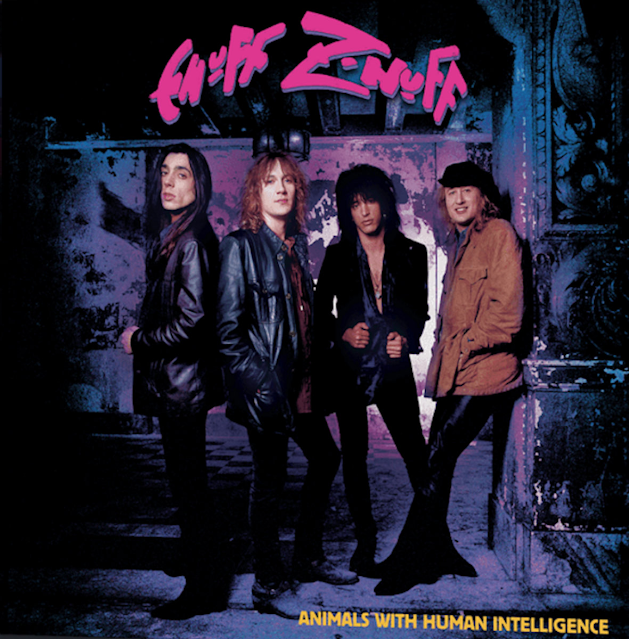 |
| The cover of the upcoming reissue of Animals with Human Intelligence on Deadline Music. |
Will this upcoming reissue set the world on fire in 2023? Probably not. Should the album get some long-overdue attention and a belated acknowledgment of its greatness? Absolutely.
As far as this writer’s concerned, an Enuff Z’ Nuff gig at some shithole on a Thursday night is infinitely more rewarding than a sold-out Saturday night arena show by an artist with less talent and feeling. No question.
If you’re my age, you likely look back at the Hair Metal years with great fondness. You also likely know that a lot of that stuff was disposable garbage. But not Chip and Donnie circa 1993. If you give Animals with Human Intelligence a listen today, you’ll quickly realize that our generation’s Lennon and McCartney were hiding in plain sight all along.
*Although Enuff Z’Nuff may not have appealed to most of The Smashing Pumpkins’ fanbase, the same certainly couldn’t be said for the band’s frontman, Billy Corgan—a longtime fan who guested on Enuff Z’ Nuff’s 1999 album, Paraphernalia.
** “Fingertips,” a track that appeared on the Japanese issue of the original album release, is said to be included on the upcoming reissue.