Photographer Unknown. Please email gaustenbooks@gmail.com if you are the photographer.
My early morning was rattled by the news that we’ve lost Taylor Hawkins at 50. It was a very sad and heavy thing to read before my first cup of coffee. He was more than an extraordinary drummer; he was a good dude.
Back in the early 2000s, I lived in Tarzana, CA at an apartment off Reseda Blvd. There was a record store right down the street on Ventura. Naturally, I’d walk over there many times a week and chat with the guy behind the counter. Taylor – a blonde ball of frenetic energy who’d bring the atmosphere up a notch or 20 just by blowing through the door – was another regular. He was one of my kind – a diehard music geek who knew the magic of hanging out at a record store. You could probably imagine the kind of sprawling conversations that took place. Never once did he bring up the fact that he happened to be a member of one of the biggest bands in the world.
One day, he came in and played a rough recording of a side project he was doing. (If I recall correctly, it was nameless at the time.) It fucking rocked! I told him I really liked it and that the groove and production reminded me a lot of early Sabbath. His eyes lit up. He got that I got it. It was one of those awesome moments that music nerds share. That was the last time I saw him before I moved back east.
I’ve never been much of a Foo Fighters fan, but I’m sure as hell a Taylor fan. Yeah, his band fills stadiums, but he was just a regular guy who loved music. He was one of us. Even if you don’t like his main gig, I promise you that you would have loved him.
I never did follow up to see if that recording he played in the store that day ever became anything. Today, I’m going to hunt through Taylor’s discography (via online sources instead of store shelves, sadly) and see if I can find it. I’ll know it when I hear it. If my journey is successful, then you can bet I’ll spend my day grooving to it like a motherfucker. Just like any music geek does when they find their treasure – and just like I knew Taylor did whenever he found something cool at that record store in Tarzana way back when.
I can’t think of a better way for me to honor him today.
With the bands that comprised the original Punk/Post-Punk era now firmly entrenched in middle age (or beyond), those acts still pushing to make a go of it in the present tense often trade on – and succumb to – the public’s notion that “original” automatically means “authentic.” There are scores of bands out there attempting to add a few more years to their careers by blowing the dust off their back catalogs and hitting clubs and festivals without a single new note to be heard. Sure, such activities tug at nostalgic heartstrings and help keep the bills paid, but it’s more than a bit disheartening to witness once creative and forward-thinking entities rely so heavily on past glories to keep the train rolling.
Late Gang of Four guitarist/co-founder Andy Gill was keenly aware of this fact. When original singer Jon King jumped ship following 2011’s Content, Gill kept the band – already beleaguered by decades’ worth of breakups, reunions and personnel disruptions – going for several more years as its sole original member. While his output during this era wasn’t always perfect, his steely resolve to keep Gang of Four alive and churching out new sounds for nearly a decade past the group's reasonably expected expiration date was admirable. (It also yielded downright extraordinary results at times; check out “The Dying Rays” – one of Gill’s greatest songwriting victories – off 2015’s What Happens Next.)
Of course, the marketplace is rarely kind to a veteran act – especially one comprised almost entirely of unfamiliar faces – that is determined to make new music. When Gill’s incarnation of Gang of Four played Boston in 2016, they served as second fiddle on a “co-headlining” bill with The Faint – and didn’t even appear on the marquee outside the venue. The harsh reality that late-period Gang of Four never truly captured the public’s imagination was made even sadder when considering that the band absolutely fucking smoked that night. It was only upon Gill’s death in February 2020 that the masses truly embraced the fact that he had remained a thriving creative force right until the very end. Stripping away the original band's long-running internal squabbles (which, in truth, are nobody’s damn business except theirs anyway) and taking sonic integrity alone into account, there’s no question that Gill earned his place as the keeper of the Gang of Four ethos during the years he ran the show.
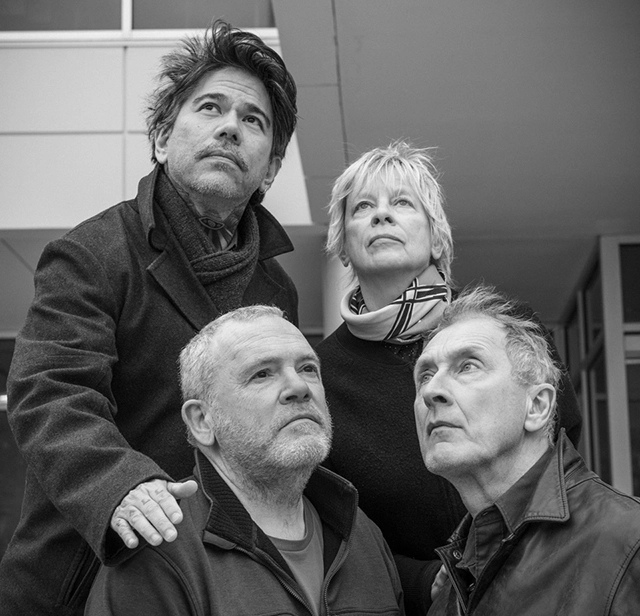
This brings us to 2022 and the band called Gang of Four that is currently on tour and played last Sunday at the Crystal Ballroom in Somerville, MA. King is back at the mic, and the drum stool is again occupied by original timekeeper Hugo Burnham. Veteran bassist Sara Lee, who played on 1982’s Songs Of The Free (my all-time favorite Gang of Four record, for what that’s worth) and 1983’s Hard, is back as well. David Pajo, best known for his time with late ’80s/early ’90s cult heroes Slint, is on guitar. That is quite an impressive assemblage of musicians, but does it measure up to the Gang of Four legacy?
Well, yes and no.
First of all, without Gill, nothing presented under the name “Gang of Four” would ever feel complete. But since the band has no choice in that matter, what any of us could ever hope for is something that preserves the man’s spirit and contributions. That’s exactly what the sold-out crowd in Somerville got from Pajo, who stepped into Gill’s formidable shoes and delivered the second-best option any Gang of Four fan could experience. An incredibly innovative player in his own right (check out his Bandcamp for a slew of treasures), Pajo brought honor and respectability to his role, perfectly reproducing Gill’s sonic presence while incorporating enough of his own stylings to add something fresh to the proceedings. (I’d like to think that Gill – never one to stay in one creative space for too long – would have viewed the injection of Pajo’s musical ingenuity into the Gang of Four sound with an approving nod.) Additional kudos to the guy for not aping Gill’s signature stage moves – a wince-inducing trait that is far too common among replacement performers. (I’m looking at you, Paul Rodgers.)
Here’s a sentence that I would never type lightly: David Pajo is the guitarist for Gang of Four.
Fucking stellar.
While fully acknowledging the logistical constraints the band surely faced in light of a pandemic and the general demands of prepping for a tour (including figuring out the merch; more on that later), I must say that the lack of any new material in the band’s set was a letdown. Sure, the band’s recent 77-81 box set has duly earned a Grammy nomination and everybody loves the old stuff, but this band deserves better than to exist as a mere nostalgia act – especially with a powerhouse like Pajo in tow. Gill would have undoubtedly given us something fresh to digest had he been able to bring Gang of Four to the stage in the here and now, and his unwavering devotion to such progress is sorely missed. Say what you will about the group’s songs post-King, but they at least existed.
This current band will never truly be Gang of Four until it has something new to offer.
That said, the Somerville gig was magnificent. Forty-five years after the band’s formation, Gang of Four delivered a performance that shook off the shackles of tragic loss and internal fractures and celebrated the true magic of its classic material. The sixtysomething King was in brilliant form, practically sweating out his full body weight while thrusting himself around the stage as the team of Burnham and Lee expertly anchored his menace. In addition to playing the requisite material off 1979’s Entertainment! and 1981’s Solid Gold, the band showcased a few tunes off Songs Of The Free (including a pristine rendition of “Call Me Up”), brought out “Capital (It Fails Us Now)” off 1982’s Another Day/Another Dollar during the encore and even gave a nod to their ‘90s discography via the inclusion of “I Parade Myself” off 1995’s underrated Shrinkwrapped. Best of all, the band members clearly enjoyed themselves. (Smiles? On stage at a Gang of Four show??!! Why the hell not???!!!)
The coolest highlight? The proud look on Burnham’s face as his daughter, Ts, sang backing vocals at various points throughout the set in a “Black Lives Matter”- emblazoned outfit.
I’ve written about Gang of Four more than any other band in my career; this music means the world to me. As an eternal member of Team Andy, I offer these words directly to the current band:
Thank you so very much for doing this tour. It’s so lovely to experience these songs again in a live setting when I thought that possibility had been lost forever. This music matters so much. You’ve made the absolute right choice with Pajo. Please keep this going and write some new shit! My best wishes to you all. And as always, my deepest fondness and respect for your fallen musical partner.
Bonus Fun Fact: A few months back, I suggested to Hugo that Gang of Four should sell band-branded condoms "for our top left pockets." (Some of you will get that reference, surely). Well, not only did they use my idea, but Hugo hooked me up before the gig. I told him the band needs to hire me full time for the next tour!
Note: The following review was originally written in October 2021 during Cradle of Filth’s "Lustmord and Tourgasm" Tour for another website. After some logistical/technical issues and delays, it appears here for the first time anywhere.
When this writer entered the Paradise Rock Club in Boston on an early October night, two things quickly met my eyes: A seemingly endless line to a merch table selling black apparel and an aesthetically pristine Goth girl being led around by a leash held by her male companion. These were welcome sights for three reasons: 1. Goth ladies are lovely, especially on a Saturday night this time of year, 2. Brisk swag sales indicate a rebounding tour industry and 3. The incomparable Cradle of Filth has returned to America.
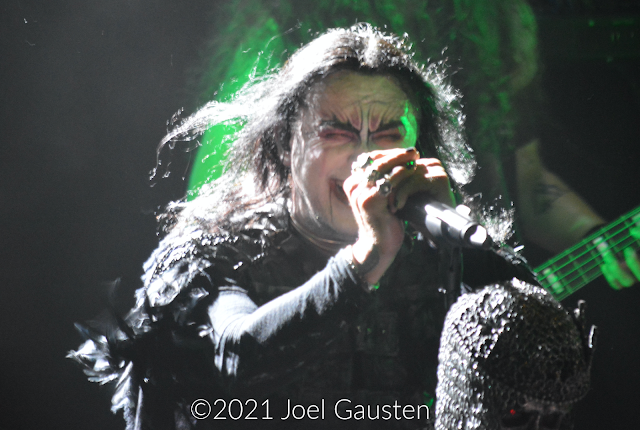
As COVID-19 continues its grip on Beantown and beyond, a live Cradle of Filth show in 2021 provides both escapism and an inspiring statement on the power of resilience. In regard to the latter, this ever-evolving crew of English extreme Metallers has been at it in one form or another for 30 years now. When I interviewed then-guitarist Paul Allender way back in 2000 shortly after the release of the band’s fourth album, Midian, the group had already reached legendary status for taking the typically abrasive sounds of Black Metal to more musically precise – and often heavily symphonic – levels. More than two decades later, leader Dani Filth and his revolving door of bandmates (including newest recruit Anabelle Iratni on keyboards and vocals) are underground scene survivors who still deliver the absolute best of the genre they revolutionized with 1994’s The Principle of Evil Made Flesh, 1996’s Dusk…and Her Embrace and other seminal releases.
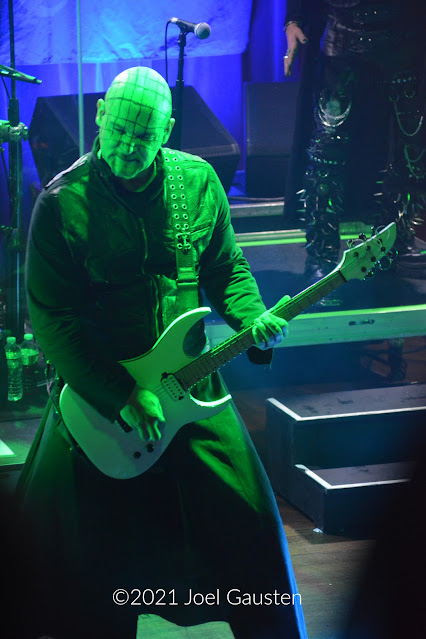
Marek "Ashok" Smerda of Cradle of Filth
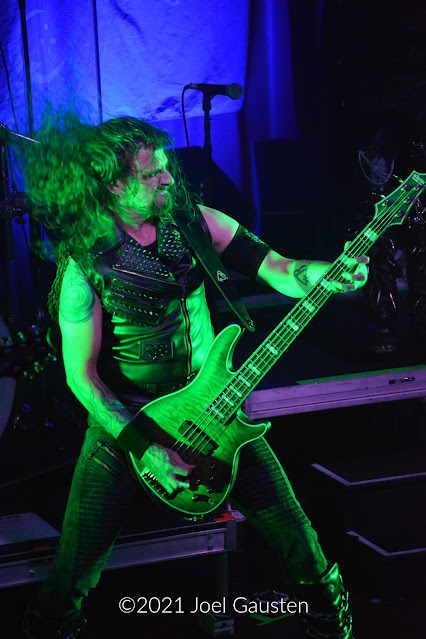
As for escapism…well, with a current tour setlist including song titles like “Desire in Violent Overture” and “The Twisted Nails of Faith,” it’s safe to say that attending a Cradle of Filth gig means taking a journey into a fantastical world that is utterly perfect for the Halloween season. Drawing from various high points in its lengthy career (and boasting the added attraction of playing its 1998 album Cruelty and the Beast from start to finish), the group delivered a pummeling performance that spotlighted undisputed classics (“Cruelty Brought Thee Orchids,” “From the Cradle to Enslave”) while introducing enthralling new tracks (“Crawling King Chaos,” the incredible “Necromantic Fantasies”) off its latest (and best-in-years) album, Existence Is Futile. The expert onstage musicianship reached near-Prog levels at various points (especially during an impressive interpretation of Iron Maiden’s “Hallowed Be Thy Name”), while each of the band’s six members provided a lesson on what it means to actually perform on stage. (Full marks to guitarist Marek “Ashok” Smerda for frequently acknowledging and engaging with audience members from his side of the stage throughout the show.) Whether growling from the pits of Hell or spewing spine-shivering shrieks, Dani’s voice – always an integral part of the Cradle of Filth experience – has not diminished one iota over the years. Unlike most decades-old acts, this band has only become more powerful with age.
Daniel Firth of Cradle of Filth
Although the ghoulish makeup and macabre imagery may entice audiences through the door, it’s the extraordinary musicianship anchoring the madness that truly matters. Cradle of Filth’s greatest attribute has always been its exceptionally crafted compositions. The rest is just the black icing on the cake.
Alexis Mincolla of 3Teeth
Direct support came from Los Angeles-based Industrial act 3Teeth, whose strobe-heavy, potentially seizure-inducing set showcased captivating sounds strong enough to please both older scene veterans who remember when classic Wax Trax! releases were fresh in stores and newer-school fans who first embraced the genre via Rammstein. Looking like a cross between My Life With The Thrill Kill Kult’s Groovie Mann and Tool’s Maynard James Keenan (and sounding like it – with a touch of Rob Zombie thrown in), frontman and former Boston resident Alexis Mincolla engaged his hometown crowd through an onstage persona steeped in dark menace. (Mincolla’s antics paid off, as the crowd’s between-song chats of “TEETH! TEETH!” were often as loud as the band’s music.) How to sum up the band’s image and vibe? 3Teeth is the kind of ensemble you’d spot playing in an underground S&M club in a ’90s-era horror film. That said, the group achieves the rare feat of clearly charting its own creative course while still offering something familiar. Yes, this crew’s music and image give more than a passing nod to the past, but everything it offers an audience is undeniably 3Teeth. Fantastic stuff.
Lauren Hart and of Max Karon of Once Human
Helmed by former Machine Head/Soulfly guitarist Logan Mader and fronted by stunning singer Lauren Hart, Once Human kickstarted the evening with an all-too-brief barrage of savage female-driven Metal. (Think Crisis or the heavier moments from latter day Arch Enemy.) Based on this writer’s repeated listens to an advance copy of their forthcoming third album, Scar Weaver (out February 11), this current tour could end up being the final time anyone will need to hit a venue super early to catch Once Human live. It is not hyperbole to say that Scar Weaverwill be a Metal genre game-changer in 2022. I’m talking a Beneath The Remains-level third album breakthrough here. You read it here first, folks.
Today is the 42nd anniversary of Metal Box, the second album by Public Image Limited (PiL) and easily one of the most innovative albums ever created by humans. Don’t believe me? Well, consider the fact that one of the most mind-blowing releases of 2021 is a reimagined version of the damn thing...
Released last Friday by Cleopatra Records, Metal Box - Rebuilt in Dub is the latest album by original PiL bassist and veteran sonic alchemist Jah Wobble, who has reworked and re-recorded eight of the original album’s 12 tracks (plus two earlier PiL numbers) with help from former Siouxsie and the Banshees/Specimen guitarist Jon Klein (who, along with Wobble, also contributes drums). Of course, recording a new version of Metal Box in 2021 is a bit like repainting the Mona Lisa – and a surprising move from a man who didn’t have a shred of interest in revisiting PiL material just a few years ago.
“I wouldn’t have touched it with a barge pole,” he says of the not-too-distant past. “I would have been sniffy – offended – if anyone had dared to say I should go back and do PiL stuff.”
That all started to change about a decade ago when he slowly began adding PiL tracks here and there (and often in drastically reworked fashion) to the repertoire for his long-running solo band, Invaders of the Heart. Then came the extraordinary 2017 Invaders of the Heart album The Usual Suspects, which ended up featuring three PiL covers. (Anyone reading this must check out the album’s mesmerizing version of 1978’s “Fodderstompf” at least once in their lifetime.) Along the way, he gradually retooled some of the arrangements for the Metal Box-era PiL tracks he brought back to the stage.
The idea to go full bore into a (nearly) complete re-do of Metal Box was not a response to Wobble’s renewed interest in PiL, but rather an idea pitched to him by Matt Green at Cleopatra. Wobble’s relationship with the label began via his appearance on last year’s all-star Pink Floyd tribute album, Still Wish You Were Here. (Here’s something you probably couldn’t have imagined: The album’s rendition of “Have a Cigar” features Wobble alongside former Damned drummer Rat Scabies, former Billy Idol guitarist Steve Stevens, former Yes/Moody Blues keyboardist Patrick Moraz and – get this – Dream Theatre’s James LaBrie!) Much to the eventual joy – and, let’s face it, utter fucking shock – of PiL fans the world over, Wobble jumped at the chance to actually give Metal Box another go.
“I think [Matt] was surprised, because I think he thought I would say, ‘I don’t know; I need to think about it.’ I said yes because I already had an idea of what I would do with that.”
What Wobble did was create a fresh-sounding album that honors Metal Box’s magic while incorporating new levels of esoteric flare. Interestingly, four songs from the original album (“Bad Baby,” “No Birds,” “Chant” and “Radio 4”) are absent from Metal Box - Rebuilt in Dub in favor of including a double-shot of new versions of “Public Image” and “Fodderstompf” off 1978’s First Issue. While bypassing 25 percent of the album may be a head-scratcher to some, Wobble believes this decision brought a sense of cohesion to his latest endeavor.
“I just thought what I got there was a nice balance. That was the balance as a kind of thematic record […] I thought I was going to miss [the other tracks], but as I worked with it, I thought, ‘This is feeling right’ - the tempos and the fills and everything. I altered some of the tempos, and some of the keys are different from the originals. They segway into one other nicely.”
Metal Box - Rebuilt In Dub features guest appearances by Invaders of the Heart member George King and his wife, Katy, who adds violin. Keiko Yamazaki provides backing vocals on "Fodderstompf." Klein’s work on the album grew out of his heavy participation as a tutor with Tuned In, Wobble’s community music project based in the London Borough of Merton.
“We’ve been doing that in South London for the last few years. It was my idea to get older people who were maybe socially isolated to play music again. Well, it’s turned out to be a really successful venture; we get women, young women and men come. It’s a very wide range of people – some people who maybe got homeless issues through to people living in the nicer, leafier parts of South London who want to come and play. It’s like a club, really. Jon’s a fantastic guitarist, and we really work well together. We’ve worked on a couple of things together, and he’s become a good friend of mine. As lockdown progressed, we couldn’t continue with Tuned In because of COVID. So, Jon and I started doing it on Zoom with people. Not everybody had the wherewithal to sign up for Zoom and do it that way, but we did it and made lots of recordings.”
When Klein received Wobble’s offer to come on board for Metal Box - Rebuilt in Dub, the guitarist’s response was swift and enthusiastic.
“Jon was heavily involved. I would send him stuff back and forth for the guitar parts. He put some of the drums down as well. It was really the two of us in tandem.”
Perhaps the greatest thing about Metal Box - Rebuilt in Dub is that the drums on it absolutely kill – a massive feat when considering the talents of those who played on the original album. In addition to Wobble keeping the beat on “Careering” and “The Suit,” Metal Box featured drumming by Richard Dudanski (The 101ers) and David Humphrey (Sparks/Mike Oldfield/Reflex). Then-PiL guitarist Keith Levene even jumped behind the kit for “Poptones” and "Radio 4." This revolving door of percussionists in the studio was finally closed with the arrival of future Pigface/Killing Joke/Ministry skin basher (and longtime music industry entrepreneur/onstage spitting enthusiast) Martin Atkins, who joined the fray in time to perform on the track “Bad Baby” and become as “permanent” a PiL member as anyone not named John Lydon could ever hope to be. Wobble is quick to speak highly of Atkins’ impact on the group.
“It was such a fractious kind of band; it was so mad that you’d just feel that somebody wasn’t going to fit in. We needed a drummer for the American tour as much as for the last track or two of that album. So, he came along. I wanted somebody steady. It’s so hard to find good drummers, I think. He had a great hi-hat, and he was very influenced with Disco. That got him the gig. His timing was good; he’s a good drummer. The first drummer in the band, Jim Walker, was very, very good. He was really the band drummer. No one [else] fitted in up to the point Martin came in, to be honest. It’s not knocking any of them. There was a guy, Dave Humphrey, who was a nice guy, but he was quite straight. Very good drummer; he played on ‘Death Disco,’ I think – a couple of tracks. But it was such a mad group at times; it was difficult for someone who’s very straight […] A lot of drummers tend to be quite straight; there aren’t a lot of bullshitty grey areas in the way you’ll find with guitarists – sorry, I’m joking! Martin was a nice guy. Thank God he was there; otherwise, I would have been triple lonely on that last tour [I did with PiL]. He was a guy I could have a beer or breakfast with.”
While PiL sporadically exists to this day (albeit in a vastly different form), it is fair to say that many of the group’s die-hard followers cite First Issue and Metal Box – and the original Lydon/Levene/Wobble incarnation – as the peak of the band’s career. (Of course, many fans would argue that 1986’s Bill Laswell-produced Album is also pretty goddamn sensational – something that Wobble readily acknowledges as well). PiL’s late-’70s era represents a rare – and often volatile – combination of personalities operating under unconventional circumstances. In Wobble’s mind, the original trio’s odd creative existence is precisely why the band ultimately translated so well to vinyl at the time.
“We didn’t have a manager. Can you imagine? We were quite aggressive towards the record company at times, like, ‘Get the fuck away! We’re gonna do what we’re gonna do.’ I was a fledgling player who was allowed to bring my fledgling talent to the fore. That wouldn’t have happened in many bands; I would have been ordered to play root notes of the guitarist’s chords. So, that was fantastic. It was very kind of off the wall. You’ve got these three weird individuals floating around London at the time. Somehow, these three oddballs then go into a studio without too much supervision. There was a producer there to start with, but we had no real respect […] It’s funny; I fancied the job with the bass, and I had an idea of how sounds could be mixed somehow. It was a confidence there that one wouldn’t normally have with other areas. I think things happen where there’s a coming together of a number of factors. Somehow, those factors are allowed to come together in a very organic way.
“Art historians always say that music follows the visual arts; it lags about 30-40 years behind, generally,” he adds. “I think we very much had the sensibility of the hedonistic, crazy fucking Abstract Expressionists of the ’50s.”
Now, 42 years after Metal Box, the world is still largely catching up to what Jah Wobble and the rest of PiL created so long ago. And at 63, he remains fully immersed in the world of sound and its endless possibilities.
“I find such solace in the music, and the music really inspires me as the nearest fucking emanation of that supreme consciousness – call it what the fuck you will. By always staying with that, you’re closer to the source and you're likely to be true to yourself.”
These haven’t been the best of times, and the world needs live music now more than ever. People also need a reason to let out some real laughter. It’s quite rare to experience both at the same time, but that’s what former Yes keyboardist/Prog Rock legend/absolute nutter Rick Wakeman delivered during his recent stop in Derry, NH on his current “Even Grumpier Old Rock Star” US Tour.
A sequel to his 2019 “Grumpy Old Rock Star” Tour (which shared its name with his 2008 book), Wakeman’s current solo jaunt finds him entertaining fans with selections from his 50-year music career and a heavy dose of his fantastic brand of brilliant – and often quite bawdy – humor. (Think Mozart meets Graham Chapman.) One only needs to take a look at the man’s notorious dirty joke-filled acceptance speech during Yes’ 2017 Rock & Roll Hall of Fame induction ceremony to get a sense of what it’s like to spend an evening with a man who is equal parts meticulous composer and mirthful court jester. After all, anyone audacious enough to create an album like 1975’s The Myths and Legends of King Arthur and the Knights of the Round Table certainly isn’t afraid to shun convention. When it comes to the sometimes stuffy world of Prog, fans can always count on Wakeman to deliver his musical wizardry with a mischievous wink.
Without giving away too many punchlines, I’ll say that the guy is an utter riot. Whether discussing his advancing age (“I wear a pair of glasses to find the pair of glasses I’ve put down!;” “It gets harder when you get older, doesn’t it? Or maybe it’s the opposite…”), his history of heart attacks (“I stopped having them, ’cause they hurt!”) or a slew of other topics (including a story about the late Keith Emerson, a lavatory and an awards show…You really had to be there), Wakeman had the crowd in stitches with his between-song banter. These stand-up routines were juxtaposed with the sonic side of the festivities, which showcased the beauty of his talents on the keys. Every note of this performance – from show opener “Sea Horses” (off 1979’s Rhapsodies) to the final moment of encore “Merlin The Magician” (off the aforementioned King Arthur album) – was captivating. When not gifting the crowd with solo material, he performed classic songs (often infused with hysterical introductory tidbits) he recorded with the likes of Yes, David Bowie and Cat Stevens. Additionally, he performed a heartfelt tribute to The Beatles (“Help!” and “Eleanor Rigby”). For this writer, Wakeman’s loving renditions of Bowie’s “Space Oddity” and “Life On Mars?” were the evening’s most impactful numbers.
Wakeman’s return to American stages is the latest in a series of activities he’s undertaken during the COVID-19 era. In addition to releasing his latest solo album, The Red Planet, in June 2020, he revised his glorious past earlier this year with the release of Rick Wakeman’s Yes Solos, a stunning collection of some of his finest onstage moments with Yes from 1971 to 2003 (with three bonus solos recorded in 1989 during his time with the Yes spin-off group Anderson Bruford Wakeman Howe). Full marks to the guy for taking such an enjoyable show – and a chance for folks to enjoy live music and jokes again – out on the road.
ProTip: Be sure to hit the merchandise table and pick up a copy of the fantastic Even Grumpier Old Rock Star Tour programme, which features plenty of Wakeman’s wit and wisdom – as well as a biography presented as a true-or-false quiz!
Kira needs no introduction, but here’s one anyway...
Best known to Punk fans around the world as the bassist for Black Flag from late 1983 to late 1985 and one half of the two-bass project dos with Mike Watt, Kira has spent the past several years building an accomplished career as a dialogue editor for television and film. Her many credits include Joker, the 2018 remake of A Star Is Born and the second season of Game of Thrones. Additionally, she’s received two Emmys and was part of the sound team that won an Oscar for its work on Mad Max: Fury Road. Now, at 60, she has a brand-new addition to her extraordinary résumé: Solo music artist.
Out today, Kira’s eponymous 10-song debut solo album offers a considerably more subdued atmosphere than anything she played on during her days with Greg Ginn and company. For a general understanding of its immediate vibe, picture a quaint avant-garde Jazz club rather than, say, the old City Gardens in Trenton, NJ. In addition to showcasing her ever-exquisite bass playing, the album features her soothing (but nonetheless evocative) vocals on all tracks. Guests include the amazing Petra Haden (who you can read more about here), guitarist Glenn Brown and drummer Dave Bach.
The album is Kira’s latest sonic undertaking to also feature her older brother, Paul Roessler, whose life in music has included stints with The Screamers, Nina Hagen, Nervous Gender, 45 Grave, The Gitane DeMone Quartet and a host of others. Paul’s role as co-producer and musical contributor is only fitting when considering he is the one Kira credits for inspiring her to play bass to begin with. Circa 1976, Paul put together a band called Arc2 to play a primitive version of his epic 47-minute, Prog-inspired composition, “The Arc” (finally recorded in proper form and released on limited-edition vinyl in 2013). Kira, who was 15 at the time, wanted in.
“Their bass player quit, which is the exact reason that I borrowed a bass and started practicing really hard – I wanted to join Arc2. I was never good enough, and then Paul got into Punk Rock. It all works out like it’s supposed to, I guess.”
Released on Paul’s Kitten Robot label (which he founded in 2019 with singer Josie Cotton), the album was written and recorded over a 13-year period. The track listing tells a chronological 38-minute story of (in Kira’s words) “love and loss.” Many of the songs address the passing of her beloved dog Hombrito (“Little Man”), who died of cancer in 2013 at only eight years old. Fittingly, a portrait of him graces the album’s front cover.
“I kind of had to go through the whole process – the early phases and the actual loss and sort of what happens after and with a little distance from the loss. For me, it was just natural to write about this and write this story. I tend to be extremely personal and try to connect with just raw emotion and then see if I can portray that in a way that someone can connect with. The songs are chronological, but they are not all specifically on the topic of the great love of my life in some ways, which was my dog.
“I never had a child, but I raised this dog from a baby,” she adds. “It was as close as I will ever get to having a child, having that connection and going through that process of him growing ill and dying – and how it feels now afterwards. He was everything; he still is. I love my dogs that I have now, but I didn’t have them as babies; I rescued them as adults. It is different when you start from the beginning.”
Although anyone who’s loved and lost a pet will readily empathize with what Kira is expressing with this album, she insists that the emotions experienced throughout the CD are universal.
“I believe by sharing those deep feelings, others can connect with it – nothing to do with the topic per se, but it’s that raw emotion that people can tap into. For me, that was huge […] Back in the Punk Rock days, we were expressing rage and anger, and [that music] captured that so well. This is really just more of the same: ‘Okay, I’m having this sort of frustration/annoyance feeling. How do I capture that?’”
Already a feverishly prolific band, Black Flag experienced its most productive era during the Kira years, recording six albums (four studio/two live) and two EPs from 1983 to 1985. The band also blazed through nearly 300 shows during that same time period. Those facts are amazing on their own, but they become jaw-dropping when considering that Kira was also an active student at UCLA at the time. Not surprisingly, this tough-as-nails work ethic established her as a force within the predominantly male Punk/Hardcore scene and earned the admiration of her fellow musicians.
As former Black Flag singer Henry Rollins noted in a statement sent to this website, “[Kira] was a mere slip of a woman, but physical size really didn't matter. She was in one of the most ferocious bands at the peak of violence in that scene in the '80s. She was as tough as any of us and could stand up to anything.”
Thirty-six years after Kira’s departure from the band, Black Flag remains one of the most lauded contributors to the history of American underground music. Interestingly, she believes that much of the group’s ongoing cultural relevance has little to do with the actual sounds it created.
“A lot of people who’ve heard of Black Flag haven’t necessarily heard Black Flag. It’s a concept; it sort of represents something. It’s sort of like the words ‘Punk Rock;’ what is the actual meaning? In a sense, Black Flag became this set of words that represented something much larger than the band actually was. If you played Black Flag music for a bunch of different people, you wouldn’t necessarily get the kind the impact response than if you just talked about it or showed them the logo. Back then, it was one of the few bands that was touring as extensively as it did, so it was a little more well known than a lot of the local bands that played maybe New York or LA and big cities but didn’t play three gigs in Louisiana or five gigs in Florida. So, that helped, but we were starving; we didn’t make a lot of money. People think now, ‘You guys were so big,’ but we were not big in the commercial scheme of things. We were sleeping on peoples’ floors and living off of $10 day per diems. It was not the glamorous lifestyle. But the big transition really started with bands like Nirvana and the Chili Peppers saying they were hugely inspired by Punk Rock – and maybe the LA Punk scene specifically. Maybe Black Flag was even specifically mentioned, and these bands did get huge. They were saying, ‘Hey, these are our roots.’ I think that made people start diving in. There is this mystique because of the logo, because of the name and because of the spread across the country that allowed it to become something defined. Not all bands could [do that]. People have heard, let’s say, the name ‘The Germs,’ but you can’t quite grab onto it. There was enough to grab onto with Black Flag that it actually stands upright as a thing. But I really don’t think it’s much about the music; I could be wrong. If you asked someone, ‘Hey, what’s your favorite Black Flag song,’ I don’t think there would be one for a lot of people. And that’s okay. It’s like ‘Punk Rock;’ it’s more of a concept than necessarily something you can explain and have a definition of.”
As for the records she performed on with Black Flag, she cites 1985’s In My Head as the one that resonates the most with her.
“There’s something about In My Head that people may not necessarily glom onto the way I do, but I was there. That could have well been an instrumental record. We were jamming most of those songs as instrumentals, like we did. We had a lot of instrumental stuff, but Henry started to write lyrics. When Henry is singing his own lyrics, there’s an emotion to it that he doesn’t always capture with other songs. He gets intense, but especially with Greg’s songs, he couldn’t necessarily identify as closely as something he wrote himself or something of course that [former bassist] Chuck Dukowski wrote, because Chuck wrote the most amazing anthems in Black Flag. But Henry was actually sitting down and writing. In a sense, [In My Head] was the most collaborative and the most of Henry expressing his own true feelings. I’ve always had a soft spot for the way those songs became the way they are.”
Nearly a quarter-century later, Kira found herself again recording Black Flag material in the studio – this time for the 2010 release Gimmie Gimmie Gimmie: Reinterpreting Black Flag. As the title suggests, the six-song, worth-seeking-out EP features vastly different arrangements of classic Black Flag tunes. The release boasts appearances by Blondie’s Jimmy Destri, The Plimsouls’ Peter Case, Mike Watt, Saccharine Trust’s Joe Baiza and original Black Flag singer Keith Morris, among many others. Invited by former Black Flag singer/guitarist Dez Cadena to participate in the project, Kira provides lead vocals on a Patsy Cline-tinged cover of “Nervous Breakdown” and plays bass and sings on a rendition of “Gimmie Gimmie Gimmie” that is absolutely nothing like the original. Kira looks back on the release with great fondness.
“I think [the EP] hangs together as an interpretation as well as anything I’ve heard, and I often point to it as something I’ve done that I’m proud of and thought was a very creative, cool project.”
Although Kira’s profile in the national underground circles grew exponentially upon her arrival in Black Flag, she was already well established in the Los Angeles scene via her time in a variety of bands, including Waxx, The Visitors, Geza X and the Mommymen, The Monsters, Sexsick, Twisted Roots and DC3. This writer’s personal favorite of the lot, the adventurous and brilliant Twisted Roots, formed in 1981 as a way for Paul, former Germs guitarist Pat Smear and the rest of the new band to focus their attention away from grieving the recent death of their friend Darby Crash. Kira, drummer Emil McKown (later of a pre-Kira lineup of Black Flag) and singer Maggie Ehrig completed the band’s original lineup.
“For me, Twisted Roots – especially the first incarnation – was a somewhat unique experience musically. I went to school with Maggie in the 12th grade and met her there. I was telling her about Punk Rock while she was still a hippie girl. I corrupted her into Punk Rock in our cooking class. It was some of the first times my basslines got a certain amount of freedom. Because the structures of the songs were not my own, I started to learn to write basslines that actually complemented the music. I think it was some of the earliest times when I got a little bit free with the bass parts, and Paul gave me a lot of freedom to do that. There were multiple incarnations of Twisted Roots, all of which were very special to me. Even though it wasn’t necessarily known musically for a lot of people, it was very big in my musical life. Obviously, Paul’s a big influence on me, and it was a big chunk of time for him trying to make [Twisted Roots] happen. In a lot of ways, I was just a side player trying to support him; there was a lot of me trying to figure out how to work in his framework. Until I have my own bands, I’m always just trying to find ways of supporting somebody else’s vision. In my own way, that’s what I was trying to do in Twisted Roots. It was a great experience, because sometimes people are more constraining of you, but Paul was not constraining of me.”
In 2011, fourth-fifths of the original band (with later member Gary Jacoby filling in for McKown) reconvened for a live performance at a Los Angeles screening of Dave Travis’ film, A History Lesson: Part 1, which features footage of the 1984 lineup of the band alongside live clips of The Meat Puppets, The Minutemen and Redd Kross.
“I actually said no when they first asked me, but the bass player who agreed to do it couldn’t do it for whatever reason,” Kira recalls. “When Paul and Pat came to me then, I had to do it. Of course, I was enmeshed in a very big work project and felt overwhelmed by trying to practice and get this together, but it was a great experience. I’m so glad we did it!”
(A 2012 feature by this writer on the history of Twisted Roots is available here.)
Although the stage still calls to Kira from time to time, listeners who enjoy her new album shouldn’t expect to see her take this material on the road any time soon.
“The likelihood of me touring is very low. It’s funny; life just kind of keeps moving, and that feels so far away and so difficult. It wouldn’t be the same if I did it again. That doesn’t appeal to me at all. That being said, performing live is one of those experiences that is so particular and rare; I certainly can’t say I don’t miss that and wouldn’t like to do it. So, the answer is I’m hoping to find a way to do something live performance-wise, but I haven’t figured out how. If I do perform live, it won’t be an exact capturing of that record; it will be interpretations of the songs. At this point, it’s a concept but not a reality.”
More than four decades after first picking up the bass, Kira is still creating captivating music drawn from the depths of her core emotions. With 60 years’ worth of experiences under her belt, how would she best describe herself at this point in her life?
“Bass player first and foremost – this is just who I am. Then a sound editor, dog mom, loving wife and loner.”